Here is a question most business owners avoid: if you had to step away from your business tomorrow, who would run it?

Not who would answer the phones or keep the lights on for a week. Who would actually lead it? Make the decisions, manage the team, keep the clients happy, and protect what you have built?
If the answer is “I have no idea,” you are not alone. Most small business owners I talk to have never seriously thought about it. And I get it. You are busy running the business. Thinking about who comes next feels like a problem for future you.
But here is what I learned the hard way: future you does not always get a vote in the timeline.
What Is Succession Planning?
Let me define succession planning in a way that actually makes sense for a business owner, not an HR textbook.
Succession planning is the process of figuring out who could step into your shoes, and then intentionally preparing them to do it. That is it. It is not a 50-page corporate document. It is not an org chart exercise. For a small business owner, succession planning is really just answering three questions: who could lead this business after me, what do they need to learn before that day comes, and what am I doing right now to get them there?
The succession planning process looks different for every business. If you have three employees, it looks different than if you have thirty. If you want to sell to an outside buyer, it looks different than if you want to hand the business to your operations manager or your daughter. But the principle is the same: do not wait until you need a successor to start thinking about who it could be.
Why Succession Planning Matters for Small Business Owners
The importance of succession planning hits different when you are the one who built the thing from scratch.
For most small business owners, the business is not just a job. It is your livelihood, your identity, and probably the single biggest asset on your balance sheet. According to the Exit Planning Institute, 80 to 90 percent of the average small business owner’s net worth is tied up in their company. If you do not have a plan for how that business transitions, you are gambling with your retirement, your family’s financial future, and the jobs of everyone who works for you.
Here is what I have seen happen when there is no plan: the owner has a health scare and the business goes into freefall because nobody knows how to do what they do. Or the owner finally wants to sell but the business is so dependent on them that no buyer will touch it. Or worse, the owner passes away and the family is left trying to figure out how to keep a business running that they do not understand.
Why is succession planning important? Because every single one of those scenarios is preventable. Not with a complicated framework. Just with some honest thinking, a few hard conversations, and a commitment to start developing the people around you.
How to Spot Future Leaders in Your Business
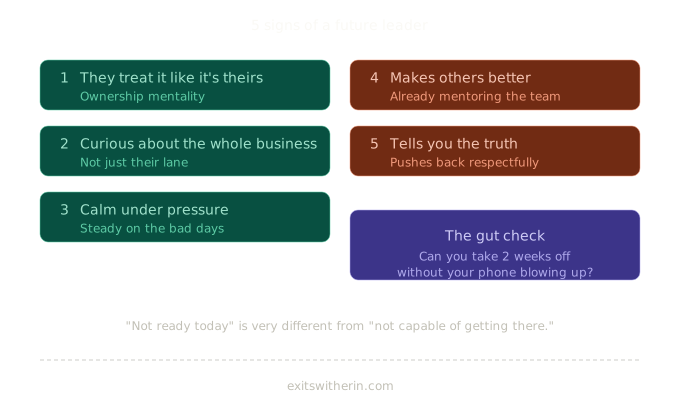
This is where most business owners get stuck. You look around your team and think, “These are great people, but none of them are ready to run this place.” And you might be right. But “not ready today” is very different from “not capable of getting there.”
Here is what I look for when I am helping business owners identify potential successors:
They treat the business like it is theirs. You know the difference between an employee who clocks in and clocks out, and one who stays late because they noticed a problem and wanted to fix it before it became your problem. That ownership mentality cannot be taught. It can be developed, but the seed has to be there.
They are curious about the parts of the business they do not touch. Your bookkeeper who asks questions about sales strategy. Your sales lead who wants to understand how pricing works. The person who is interested in the whole business, not just their lane, is someone worth paying attention to.
They can handle a bad day. Running a business means dealing with things going wrong on a regular basis. The people who stay calm, think clearly, and do not need you to hold their hand through every crisis are the ones who have leadership potential.
They make the people around them better. If someone on your team is already mentoring the newer employees, sharing what they know, and helping others succeed, that tells you more about their leadership ability than any resume ever could.
They tell you the truth. This is a big one. The person who is willing to push back on you, respectfully but honestly, is more valuable than the one who agrees with everything you say. You need a successor who will challenge you now and make hard calls later.
Practical Ways to Test and Develop Your People
You do not need a formal succession program to start developing leaders. Here are some things you can do this month:
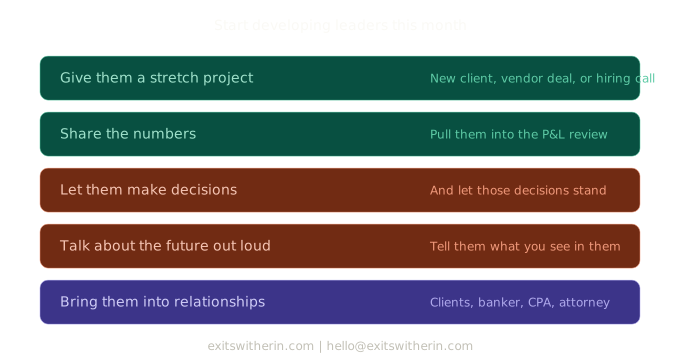
Give them a project that scares them a little. Put your potential successor in charge of something they have never done before. A new client relationship. A vendor negotiation. A hiring decision. Watch how they handle it. Not whether they do it perfectly, but how they think through it and what they learn.
Start sharing the numbers. Most employees have no idea how the business actually makes money. If you want someone to eventually lead, they need to understand the financials. Start pulling them into budget conversations, P&L reviews, and pricing discussions. This is one of the most powerful things you can do to develop a future leader.
Let them make decisions. And then let those decisions stand, even if you would have done it differently. Micromanaging your potential successor is the fastest way to ensure they never actually become one.
Talk about the future out loud. Many business owners keep their succession thoughts locked in their head. But the people you are developing deserve to know that you see potential in them and that there is a path forward. That transparency builds loyalty and commitment in a way that raises and titles never will.
Bring them into relationships. Introduce your potential successors to your key clients, your banker, your CPA, your attorney. The relationships that hold a business together are just as important as the operations, and they take time to build.
Creating Your Succession Plan
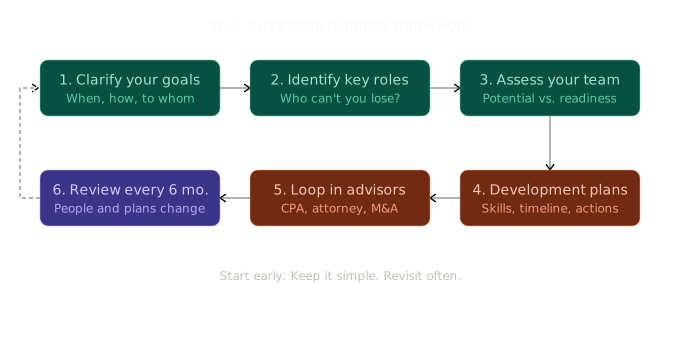
Here is a simple succession planning framework that works for businesses of any size:
Step one: Get clear on your own goals. Before you can plan who comes next, you need to know what you want. When do you want to step back? What does your financial picture need to look like for that to work? Do you want to sell to an outsider, transition to a family member, or promote from within? Your answers shape everything else.
Step two: Identify the roles that matter most. For most small businesses, this starts with you. But also think about your key manager, your top salesperson, your operations lead. Anyone whose departure would cause a real disruption.
Step three: Assess who could step up. Look at your current team honestly. Who has the potential? Who has the drive? Where are the gaps between where they are today and where they would need to be?
Step four: Build a development plan. For each potential successor, write down what they need to learn, what experiences they need to have, and what timeline makes sense. This does not have to be complicated. Even a one-page plan with three to five priorities for the next year is a huge step forward.
Step five: Loop in your advisors. Your CPA, your attorney, your financial planner, and your M&A advisor should all know about your succession plan. They will help you make sure the leadership transition aligns with your tax strategy, your estate plan, and the financial realities of the deal.
Step six: Review it every six months. People change. Businesses change. Your plan needs to change with them.
Setting Goals That Keep You Accountable
Vague intentions do not get things done. Set succession planning goals that are specific enough to act on.
Instead of “develop future leaders,” try: “Within 12 months, my operations manager will be running the weekly team meeting and reviewing the monthly P&L without my involvement.” Or: “By the end of this year, I will have introduced my top two potential successors to our five largest clients.”
These kinds of goals turn succession planning from a someday idea into a this-quarter priority.
How to Know If Your Plan Is Working
Here is the simplest test: can you take two weeks off without your phone blowing up?
If yes, your succession planning is working. You have built a team that can function without you in the building, and that is exactly what a buyer, a family successor, or an incoming leader needs to see.
Other signs things are moving in the right direction: your key people are taking on more responsibility and handling it well. You are spending less time on day-to-day operations and more time on strategy. You feel less like the business would collapse without you and more like it would continue to thrive.
And if you are not there yet, that is okay. The fact that you are thinking about it puts you ahead of the vast majority of business owners.
Start With One Conversation
You do not need to have your entire succession plan figured out today. You just need to start.
Pick one person on your team who you think has potential. Take them to lunch. Ask them where they see themselves in five years. Tell them what you see in them. Start the conversation.
That is how every successful succession plan begins. Not with a framework or a consultant or a hundred-page document. With one honest conversation between an owner who cares about the future of their business and a person who might be the one to carry it forward.
If you are not sure where to start, or if you want someone to help you think through the bigger picture of your exit, I would love to hear your story.
Erin Fitzpatrick is a M&A Advisor with Voyage Acquisitions and also provides business coaching and consulting services. She helps business owners grow their businesses, plan their exits, and figure out what comes next.You can reach her at hello@exitswitherin.com.